


Building Android 11.0.0_2.0.0 BSP Distribution
This document provides instructions for building and deploying Android 11 on the SMARC-iMX8M(Q) platform. It is based on NXP’s IMX8M_11.0.0_2.0.0_ANDROID release.
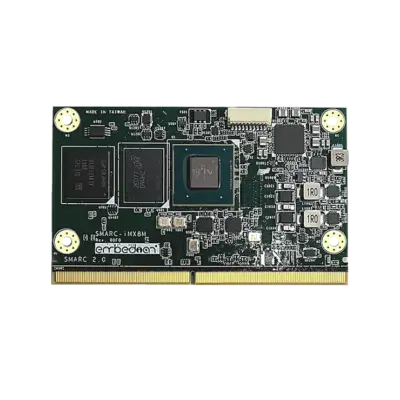
The host Linux machine is recommended Ubuntu 16.04 64 bit or Debian 9.6 64bit.
Once you have Ubuntu 16.04 LTS running, install the additional required support packages using the following console command:
$ sudo apt-get -y install git-core gnupg flex bison gperf build-essential zip curl zlib1g-dev gcc-multilib g++-multilib
$ sudo apt-get -y install libc6-dev-i386 lib32ncurses5-dev x11proto-core-dev libx11-dev lib32z-dev ccache libgl1-mesa-dev libxml2-utils
$ sudo apt-get -y install xsltproc unzip mtd-utils u-boot-tools lzop liblzo2-2 liblzo2-dev zlib1g-dev liblz-dev uuid uuid-dev android-tools-fsutils
Availability
SMARC-iMX8M at Embedian.
Carrier Board
EVK-STD-CARRIER-S20 (universal carrier board for all SMARC 1.1 and 2.0 modules) at Embedian.
Basic Resources
- NXP Android OS for iMX Application Processors
- NXP official release: https://www.nxp.com/design/design-center/software/embedded-software/i-mx-software/android-os-for-i-mx-applications-processors:IMXANDROID
Install the OpenJDK
$ sudo apt-get update
$ sudo apt-get install openjdk-8-jdk
Update the default Java version by running:
$ sudo update-alternatives –config java
$ sudo update-alternatives –config javac
Notes
The build machine should have at least 50GB of free space to complete the build process.
Obtain Source Code
Get NXP’s Android Release Package
Go to NXP’s website, download 11.0.0_2.0.0_ANDROID_SOURCE (filename: imx-android-11.0.0_2.0.0.tar.gz and put into your ~/downloads directory.
$ mkdir -p ~/android/smarcimx8mq/a_1100_200
$ cd ~/android/smarcimx8mq/a_1100_200
$ mkdir ~/bin
$ curl http://commondatastorage.googleapis.com/git-repo-downloads/repo > ~/bin/repo
$ chmod a+x ~/bin/repo
$ export PATH=~/bin:$PATH
$ mv ~/download/imx-android-11.0.0_2.0.0 .
$ source imx-android-11.0.0_2.0.0/imx_android_setup.sh
After done, it will create an android_build directory. Go to this directory.
Clone Embedian’s U-Boot (2020.04) and Linux kernel (5.10.9) sources
$ cd ~/android/smarcimx8mq/a_1100_200/android_build
$ mkdir -p vendor/embedian
$ cd vendor/embedian
$ git clone https://github.com/embedian/smarc-uboot.git uboot-imx -b smarc-8m-android-11.0.0_2.0.0
$ git clone https://github.com/embedian/smarc-fsl-linux-kernel.git kernel_imx -b smarc-8m-android-11.0.0_2.0.0
Apply Embedian’s patches for i.MX8M platforms
$ cd ~/android/smarcimx8mq/a_1100_200/android_build/device
$ git clone git@git.embedian.com:developer/smarc-imx8m-android.git embedian -b smarc-8mq-a11.0.0_2.0.0
$ embedian/scripts/install.sh
Build Android Images
Change to Android top level directory.
$ export MY_ANDROID=~/android/smarcimx8mq/a_1100_200/android_build
$ cd ${MY_ANDROID}
$ source build/envsetup.sh
$ export JAVA_HOME=/usr/lib/jvm/java-1.8.0-openjdk-amd64
$ export PATH=$JAVA_HOME/bin/:$PATH
$ lunch smarc_mx8mq-eng
or
$ lunch smarc_mx8mq-userdebug
$ ./imx-make.sh -j4 2>&1 | tee build-1.log
Notes
1. userdebug build creates a debuggable version of Android. eng build creates an engineering version of Android. Development mode enable and development tools are available on target.
2. The commands below can achieve the same result as “./imx-make.sh -j4 2>&1 | tee build-1.log“:
$ ./imx-make.sh bootloader kernel -j4 2>&1 | tee build-log.txt
# Build U-Boot/kernel with imx-make.sh first, but not to build Android images.
$ make -j4 2>&1 | tee -a build-log.txt
# Start the process of build Android images with “make” function.
Images created by the Android build for SMARC-iMX8MQ system
The images created are located at out/target/product/smarc_mx8m/ directory.
Image | Description |
boot.img | Boot image for SMARC-iMX8MQ. It contains kernel, a part of ramdisk, and default kernel command line. |
dtbo-<dtb_feature>.img <dtb_feature> | Device Tree image for SMARC-iMX8MQ to support different display output. <blank> –Support no display configuration. hdmi –Support HDMI display configuration (DCSS). dp –Support Display Port (DP) display configuration (DCSS). lcdif-lvds –Support LCDIF LVDS display configuration. dcss-lvds –Support DCSS LVDS display configuration. dual-display -Support dual LVDS+HDMI display configuration. |
u-boot-imx8mq-smarc_4g.imx | Bootloader for eMMC/SD card boot for SMARC-iMX8MQ-Q-4G Other SMARC variants could be defined at device/embedian/imx8m/smarc_mx8mq/BoardConfig.mk |
u-boot-imx8mq-smarc_4g-uuu.imx | Bootloader used by uuu for eMMC/SD card boot for SMARC-iMX8MQ-Q-4G(-I) Other SMARC variants could be defined at device/embedian/imx8m/smarc_mx8mq/BoardConfig.mk |
u-boot-imx8mq-trusty-smarc_4g.imx | Trusty Bootloader for eMMC/SD card boot for SMARC-iMX8MQ-Q-4G(-I) Other SMARC variants could be defined at device/embedian/imx8m/smarc_mx8mq/BoardConfig.mk |
u-boot-imx8mq-trusty-secure-unlock-smarc_4g.imx | Trusty Bootloader for eMMC/SD card boot for SMARC-iMX8MQ-Q-4G(-I) Other SMARC variants could be defined at device/embedian/imx8m/smarc_mx8mq/BoardConfig.mk It is a demonstration of secure unlock mechanism. |
partition-table.img | GPT table image for 16GB SD card and eMMC. |
partition-table-7GB.img | GPT table image for 8GB SD card and eMMC. |
partition-table-28GB.img | GPT table image for 28GB SD card and eMMC. |
system.img | System image |
vbmeta-imx8mq-<dtb_feature>.img <dtb_feature> | Android Verified Boot metadata Image for SMARC-iMX8MQ to support different display output <blank> Support no display configuration. hdmi Support HDMI display configuration (DCSS). dp Support Display Port (DP) display configuration (DCSS). lcdif-lvds Support LCDIF LVDS display configuration. dcss-lvds Support DCSS LVDS display configuration. dual-display Support dual LVDS+HDMI display configuration. |
vendor.img | Vendor image |
product.img | Product image for SMARC-iMX8MQ |
super.img | Super image generated from system.img, system_ext.img, vendor.img, and product.img. |
UUU Scripts
The table below describes the UUU scripts in android_11.0.0_2.0.0. They are used with the UUU binary file to download the images above into SMARC-iMX8MQ SMARC modules.
UUU Script Name | Function |
uuu-android-smarc-mx8mq-emmc.lst | Used with the UUU binary file to download image files into eMMC. |
uuu-android-smarc-mx8mq-sd.lst | Used with the UUU binary file to download image files into SD card. |
uuu_android_smarc_flash.bat | Script to generate lst file on Windows OS |
uuu_android_smarc_flash.sh | Script to generate lst file on Linux OS |
Setup SD Card
Prepare for an SD card and insert into your Linux host PC.
$ cp smarc-mksdcard.sh out/target/product/smarc_mx8mq/
$ cd out/target/product/smarc_mx8mq/
$ chmod a+x smarc-mksdcard.sh
$ sudo ./smarc-mksdcard.sh -f imx8mq -d <dtb_feature> -u <uboot_feature> /dev/sdX; sync
<dtb_feature> | N/A Support no display configuration. hdmi Support HDMI display configuration. lvds Support LVDS display configuration. |
<uboot_feature> | smarc_4g If the LPDDR4 memory capacity on your module is 4GB. smarc_6g If the LPDDR4 memory capacity on your module is 6GB. |
Notes
1. The minimum size of the SD card is 8 GB.
2. /dev/sdX, the X is the disk index from ‘a’ to ‘z’. That may be different on each computer running Linux OS.
3. If the SD card is 16 GB, use “sudo ./smarc-mksdcard.sh -f imx8mq -d <name> -u <uboot_feature> /dev/sdX” to flash images.
4. If the SD card is 8 GB, use “sudo ./smarc-mksdcard.sh -f imx8mq -d <name> -u <uboot_feature> -c 7 /dev/sdX” to flash images.
5. If the SD card is 32 GB, use “sudo ./smarc-mksdcard.sh -f imx8mq -d <name> -u <uboot_feature> -c 28 /dev/sdX” to flash images.
If primary display set to HDMI, a VESA standard HDMI display need to be connected before booting up.
Insert the SD card into your device, set the BOOT_SEL to “ON OFF OFF” and shut cross the TEST# pin to Ground. You will be able to see Android booting up. For eMMC boot, leave the TEST# floating and the BOOT_SEL should be set as “OFF ON ON”. The next section will instruct you to flash eMMC.
Setup eMMC
Setup eMMC for Android is a bit complex, but trivial. There are a couple of ways to achieve it.
Use UUU
UUU can be used to download all images into a target device. It is a quick and easy tool for downloading images. See the AndroidTM Quick Start Guide (AQSUG) for detailed description of UUU.
Make sure that the FORCE_RECOV# pin has to be shunt to Ground to enter into CPU serial download mode when using this tool. Connect USB0 min-B port of the device to your host computer.
Copy uuu.exe, u-boot-imx8mq-<u-boot_feature>.imx, u-boot-imx8mq-smarc_4g-uuu.imx, u-boot-imx8mq-smarc_6g-uuu.imx, partition-table.img, boot.img, vbmeta-<dtb_feature>.img, product.img, system.img, vendor.img, lpmake.exe, dtbo-<dtb_feature> and uuu_android_smarc_flash.bat into the same folder.
$ .\uuu_android_smarc_flash.bat -f imx8mq -d <dtb_feature> -u <uboot_feature> -e
<dtb_feature> | N/A Support no display configuration. hdmi Support HDMI display configuration. lvds Support LVDS display configuration. |
<uboot_feature> | smarc_4g If the LPDDR4 memory capacity on your module is 4GB. smarc_6g If the LPDDR4 memory capacity on your module is 6GB. trusty-smarc_4g Trusty OS, if the LPDDR4 memory capacity on your module is 4GB. trusty-smarc_6g Trusty OS, if the LPDDR4 memory capacity on your module is 6GB. |
After done, make sure that FORCE_RECOV# and TEST# pins are floating. Change the BOOT_SEL to OFF ON ON and the module will boot up from eMMC.
Use a Ubuntu 22.04 Bootable SD card
The second way that we also recommend is to make a bootable Ubuntu 22.04 SD card for SMARC-iMX8MQ. User go to our Linux Development Site to learn how to make a bootable Ubuntu 22.04 SD card. An pre-built images can be downloaded from our ftp site. Users can download those images and follow the “Setup SD card” section from our Linux development site. Once it done, you can copy the smarc-mksdcard.sh script and all Android images (u-boot-imx8mq-smarc_4g.imx, u-boot-imx8mq-smarc_6g.imx, partition-table.img, boot.img, vbmeta-<name>.img, system_raw.img, vendor_raw.img, dtbo-<name>, smarc-mkemmccard.sh) into your home directory. Follow exactly what you did for SD card, but now, eMMC device will be emulated as /dev/mmcblk0.
Insert the bootable SD card into SMARC-iMX8MQ and shunt TEST# pin to GND. Power up the device and run:
$ sudo ./smarc-mkemmccard.sh -f imx8mq -d <dtb_feature> -u <uboot_feature> /dev/mmcblk2; sync
<dtb_feature> | N/A Support no display configuration. hdmi Support HDMI display configuration. lvds Support LVDS display configuration. |
<uboot_feature> | smarc_4g If the LPDDR4 memory capacity on your module is 4GB. smarc_6g If the LPDDR4 memory capacity on your module is 6GB. trusty-smarc_4g Trusty OS, if the LPDDR4 memory capacity on your module is 4GB. trusty-smarc_6g Trusty OS, if the LPDDR4 memory capacity on your module is 6GB. |
Power off and set BOOT_SEL to “OFF ON ON”, leave the TEST# pin floating and you will be able to boot up your Android from on-module eMMC.
Android Recovery Mode
Enter board in Android Recovery mode
Shunt LID# pin to ground will enter Android Recovery mode.
Update Android Firmware
Generate OTA Packages
For generating “OTA” packages, use the following commands:
$ cd ${MY_ANDROID}
$ make PRODUCT=smarc_mx8mq-userdebug -j4 otapackage 2>&1 | tee build1-1.log
Install OTA Packages to device
- Enter to Android Recovery mode
- Select menu item “apply update from ADB”
- To the host system, perform the following command:
$ out/host/linux-x86/bin/adb sideload out/target/product/smarc_mx8mq/smarc_mx8mq-ota-<data>-<name>.zip
smarc_mx8mq-ota-${date}.zip includes payload.bin and payload_properties.txt . The two files are used for full update.
Reboot the device.
Notes
Real example name for OTA package: out/target/product/smarc_mx8mq/smarc_mx8mq-ota-20180416-imx8mq-smarc-hdmi.zip
Manual Operations
Manually Build boot.img
When you perform changes to the kernel, you may build boot.img solely instead of building the whole Android.
$ cd ${MY_ANDROID}
$ source build/envsetup.sh
$ export JAVA_HOME=/usr/lib/jvm/java-1.8.0-openjdk-amd64
$ export PATH=$JAVA_HOME/bin/:$PATH
$ lunch smarc_mx8mq-eng
or
$ lunch smarc_mx8mq-userdebug
or
$ make bootimage
Manually build Bootloader
$ cd ${MY_ANDROID}
$ source build/envsetup.sh
$ export JAVA_HOME=/usr/lib/jvm/java-1.8.0-openjdk-amd64
$ export PATH=$JAVA_HOME/bin/:$PATH
$ lunch smarc_mx8mq-eng
or
$ lunch smarc_mx8mq-userdebug
$ ./imx-make.sh bootloader -j4
It will generate u-boot-imx8mq-smarc_4g.imx, u-boot-imx8mq-smarc_4g-uuu.imx, u-boot-imx8mq-smarc_4g-trusty.imx, u-boot-imx8mq-smarc_6g.imx, u-boot-imx8mq-smarc_6g-uuu.imx, and u-boot-imx8mq-smarc_6g-trusty.imx files.
Manual build Android Linux Kernel and modules
$ cd ${MY_ANDROID}
$ source build/envsetup.sh
$ export JAVA_HOME=/usr/lib/jvm/java-1.8.0-openjdk-amd64
$ export PATH=$JAVA_HOME/bin/:$PATH
$ lunch smarc_mx8mq-eng
or
$ lunch smarc_mx8mq-userdebug
$ ./imx-make.sh kernel -j4
The kernel images are found in ${MY_ANDROID}/out/target/product/smarc_mx8mq/obj/KERNEL_OBJ/arch/arm64/boot/Image
version 1.0a, 10/28/2024
Last updated 2024-10-28